
Building systems around difficult problems.
I work where advanced research, software architecture and real-world engineering meet—turning complex computational, scientific and technological challenges into systems that are practical, scalable and built to last.
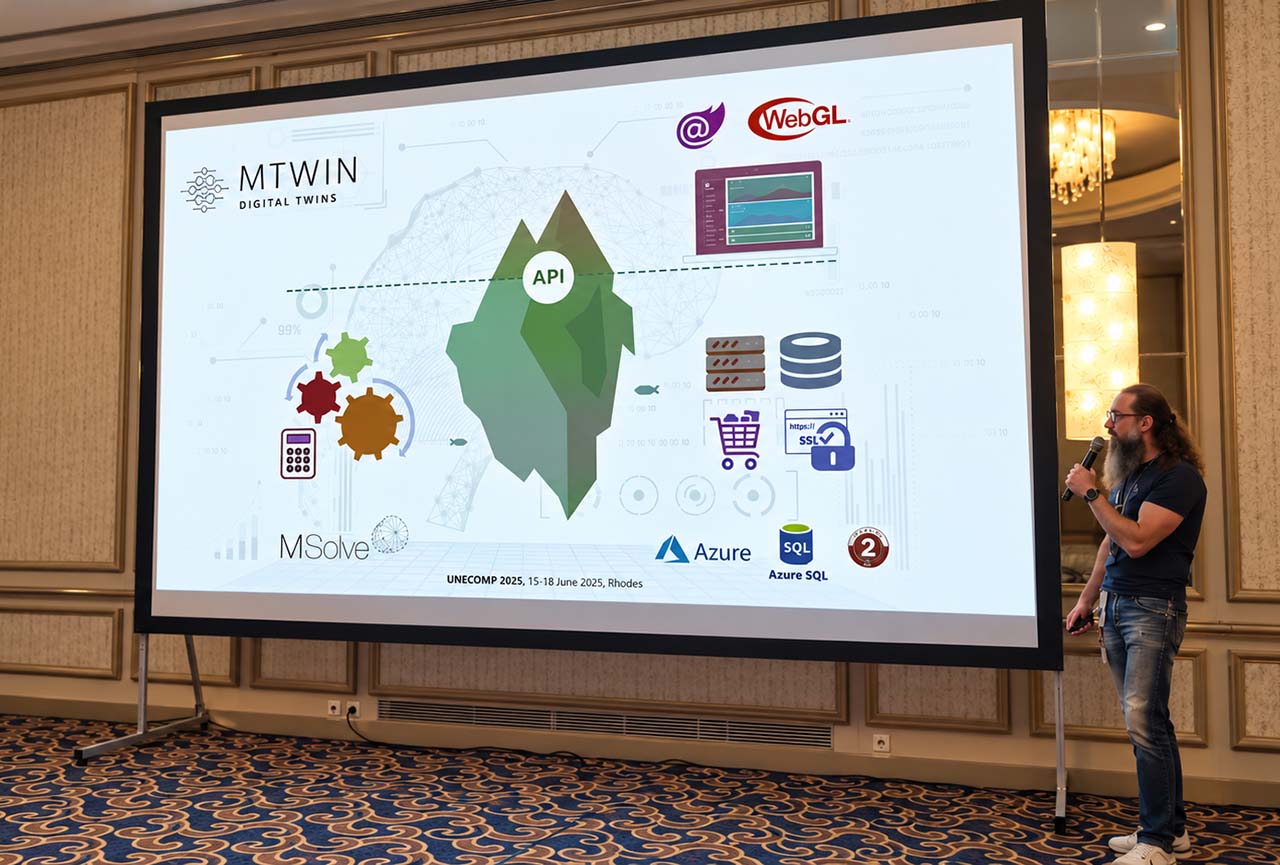
Engineering intelligence for the physical and digital world
I work at the intersection of software architecture, computational science and emerging technologies, developing systems that connect advanced research with real-world applications.
My work spans high-performance scientific computing, artificial intelligence, computational mechanics, digital twins, digital identity, Web3 and immersive technologies. Across these fields, my focus remains the same: transforming complex ideas, mathematical models and research prototypes into technologies that can operate at scale.
Rather than treating software as an isolated discipline, I approach technology as an engineering system—one in which algorithms, physics, data, infrastructure and human interaction must work together.
From research to systems
Much of my work begins with problems that do not have straightforward software solutions. They may involve solving large systems of equations arising from physical simulations, learning the behaviour of complex mechanical systems from limited data, integrating artificial intelligence with engineering models, representing physical assets through digital twins, or establishing trusted interactions between organizations through digital credentials.
These problems require more than application development. They require an understanding of the underlying mathematics, computational methods, physical systems and system architecture.
My role is often to connect these layers.
Research → Algorithms → Architecture → Software → Product
I work across this entire chain: from exploring computational methodologies and designing algorithms to defining system architectures, building platforms and bringing research-driven technologies closer to production.
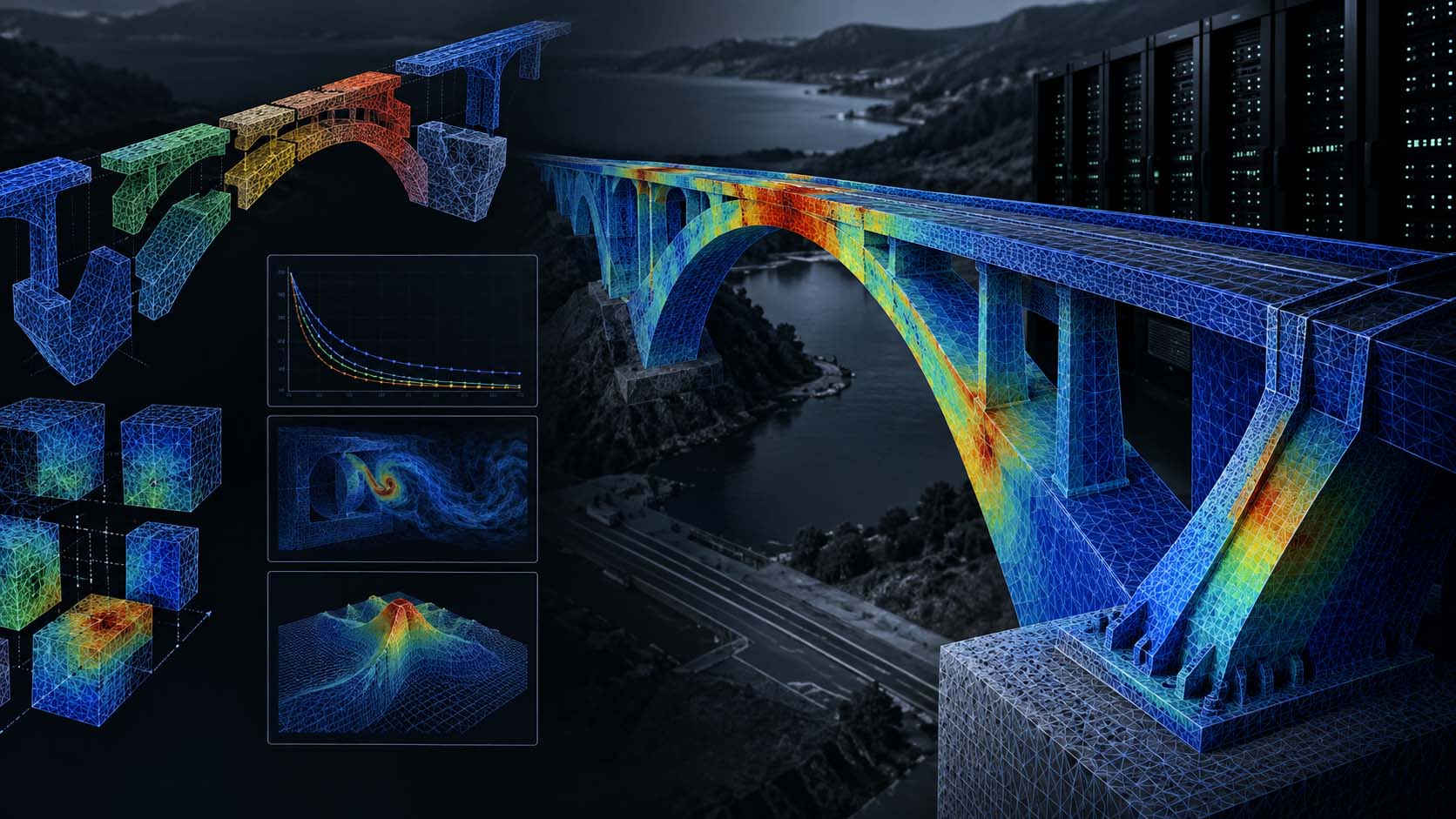
Computational mechanics and scientific computing
My research background is rooted in computational mechanics and high-performance computing, particularly the numerical solution of large-scale problems arising from partial differential equations.
A major area of interest is the development of efficient methods for solving structural and multiphysics problems, including:
- Finite Element Methods
- Domain Decomposition Methods
- FETI and related iterative methods
- Balancing Domain Decomposition techniques
- Krylov subspace methods
- Reduced-order modelling
- Parallel numerical algorithms
- Multiple-right-hand-side problems
- Stochastic computational mechanics
These techniques become particularly important when simulations contain millions of degrees of freedom, repeated analyses or large families of related computational problems. Through my work with MGroup at the National Technical University of Athens and NComp, I explore how advanced numerical methods can become the computational foundation of next-generation engineering tools.
Digital twins
A digital twin becomes powerful when it is more than a three-dimensional representation of an asset.
I view digital twins as computational interfaces to physical systems.
A mature digital twin can combine:
- geometric models;
- engineering simulation;
- sensor and operational data;
- historical information;
- machine-learning models;
- maintenance and diagnostic algorithms;
- visualization;
- and interaction with the people operating the system.
Through NComp and related research and development activities, I have worked on architectures that connect these components into digital-twin platforms for engineering and industrial applications.
The long-term direction is toward digital twins capable not only of showing what is happening, but of helping determine:
Why is it happening?
What will happen next?
What should we do about it?
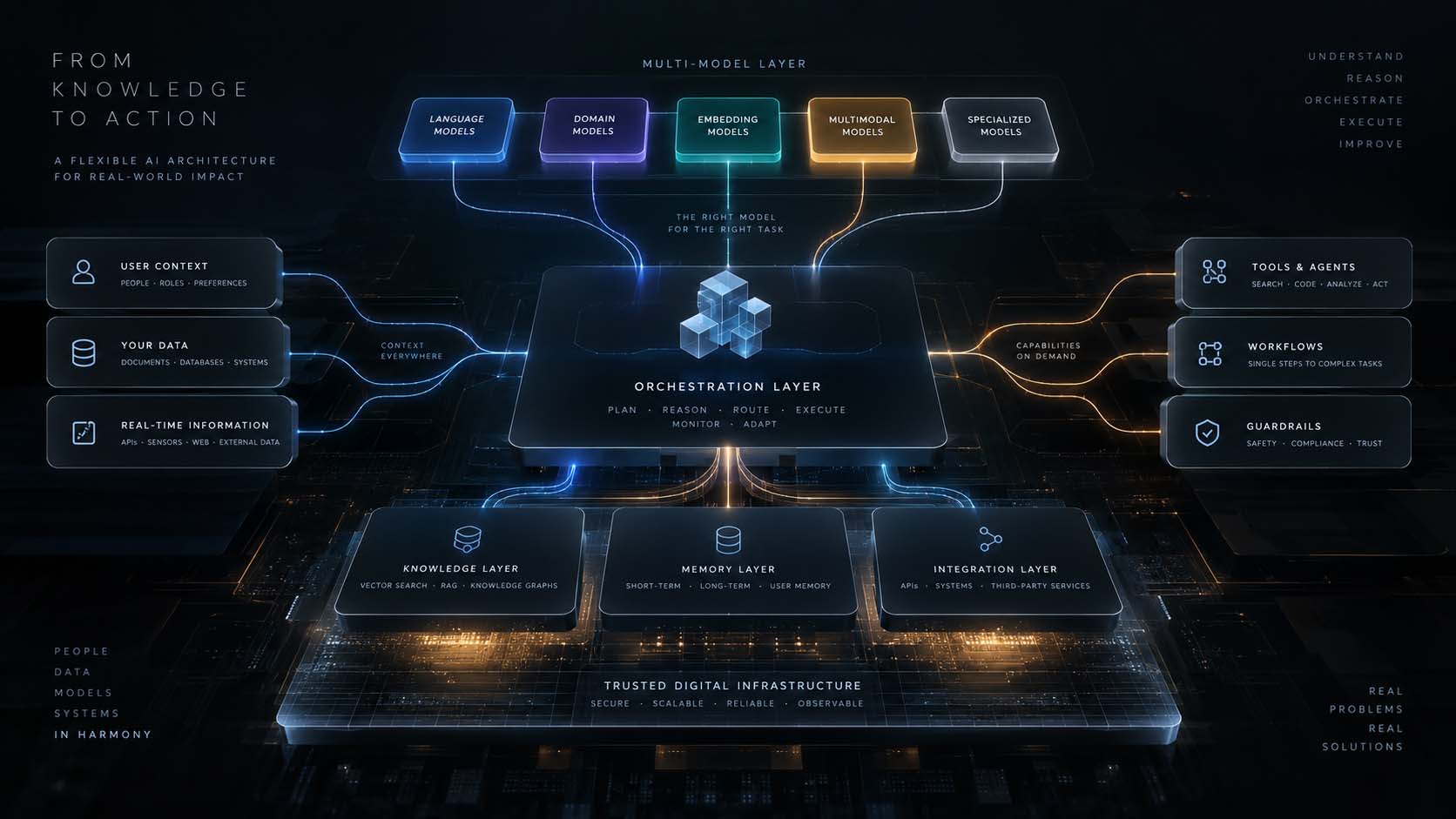
AI as a system architecture
Large language models have dramatically expanded what software systems can understand and generate. However, useful AI products require considerably more than connecting an application to a model.
My work with AI focuses increasingly on the architecture surrounding the model:
- contextual data;
- retrieval systems;
- domain knowledge;
- orchestration;
- structured workflows;
- specialised models;
- guardrails;
- evaluation;
- and application-specific intelligence.
The underlying LLM can evolve. The enduring value lies in the system built around it.
This philosophy influences my work on AI platforms, scientific applications and products such as Hansha, where artificial intelligence operates within purpose-built workflows rather than functioning merely as a general-purpose chatbot.
Trusted digital infrastructure
Another part of my work focuses on how people, organizations and software systems establish trust in the digital world.
Through my work with Compellio, I have been involved with technologies around:
- digital identity;
- verifiable credentials;
- Digital Product Passports;
- decentralized infrastructure;
- Web3;
- blockchain-based verification;
- EUDI Wallet ecosystems;
- and trusted data exchange.
The most important question in these systems is not blockchain itself; it is: How can one digital entity prove something to another without requiring them to blindly trust the same intermediary?
This shift toward portable identity, verifiable information and machine-readable trust has implications far beyond financial applications—from industrial products and supply chains to education, cultural heritage and public services.
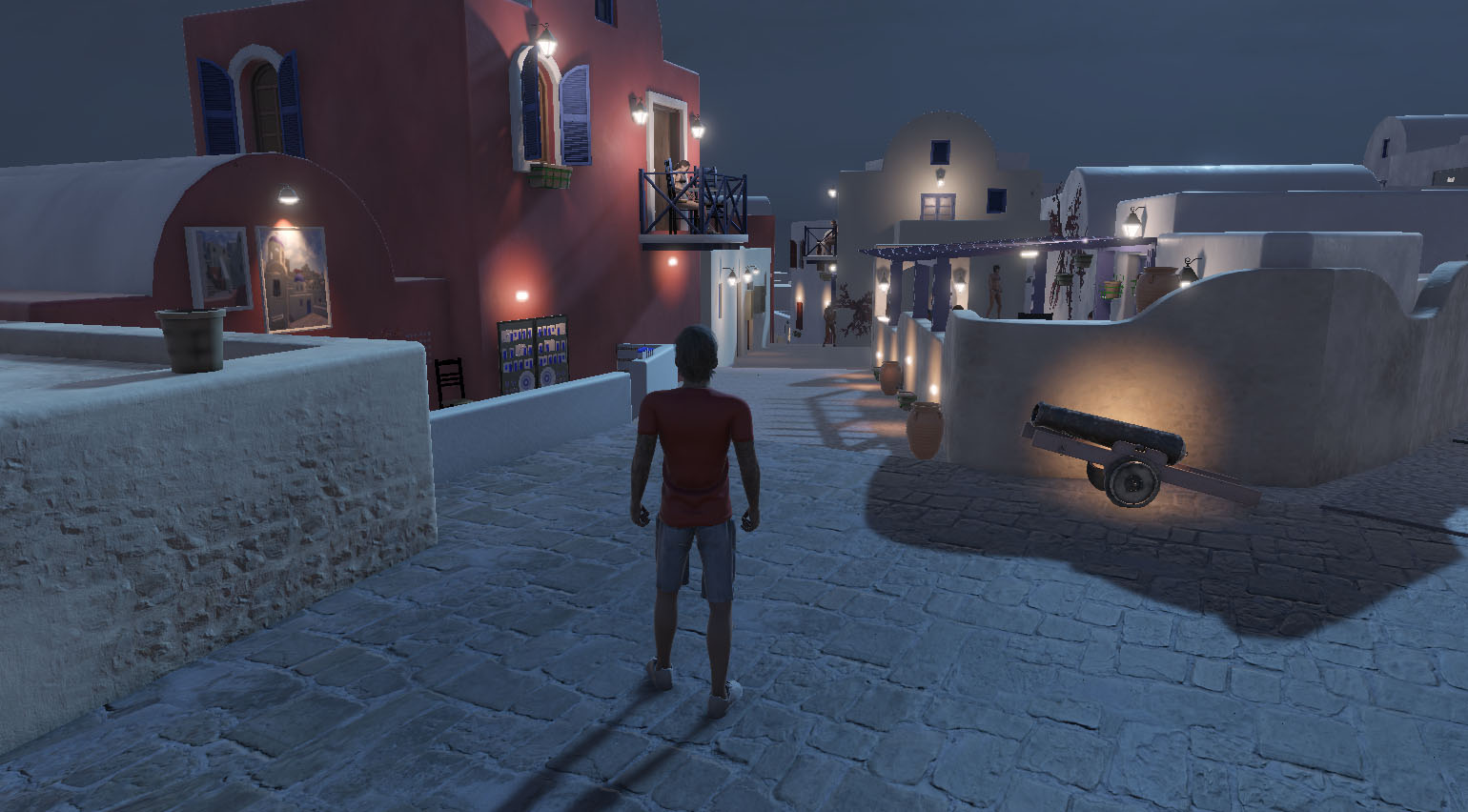
Immersive computing
Simulation does not need to remain behind engineering interfaces and numerical tables.
Through Noumenon and collaborative projects, I also explore how real-time 3D technologies, game engines, XR and artificial intelligence can become interfaces to complex digital systems. These technologies make it possible to move from looking at information to entering and interacting with it.
Digital twins can become explorable environments. Historical worlds can become interactive. Engineering data can become spatial. AI-driven entities can inhabit virtual environments and respond dynamically to the people within them.
My interest in gaming and immersive technologies therefore extends beyond entertainment. Game-engine technology is becoming an increasingly important computational interface between simulation, data, AI and human experience.
Synergy
My work typically operates across three levels.
Research
Exploring new computational methodologies and investigating how emerging technologies can solve difficult scientific and engineering problems.
Architecture
Turning those ideas into coherent technological systems: selecting architectures, defining interfaces, structuring data and deciding how individual technologies should interact.
Execution
Building the software, infrastructure and teams necessary to transform those architectures into operational platforms and products. The ability to move between these three levels has become central to how I approach deep technology.
I am interested in collaborations around scientific computing, AI for engineering, digital twins, simulation, emerging digital infrastructure and research-driven technology development.
For research, technology partnerships, advisory work or ambitious deep-tech projects:
Let’s build something difficult.